
Plasma Astronomy: a Different View - Part 2
State
Introduction
Among people interested in the Bible and the origin of the universe, several questions can arise. One, that of the apparent great age of stars, has been dealt with in several other articles. 1 2 3 This article deals with another question that can arise in the cosmology arena: the validity of plasma astronomy and plasma cosmology. The relevance of this question, of the validity of plasma astronomy, is in part due to plasma astronomy's ability to provide solutions to several problems in conventional astronomy and cosmology, its potential validity in future research, and its being a component of the cosmology model of Setterfield. 4
First, briefly I shall explain what plasma astronomy is. Plasma astronomy refers to the incorporation of plasma and electromagnetic concepts in astronomy. Plasma itself is a collection of electrically charged particles, so electromagnetism is implicit within plasma science. As pointed out in the previous article of this series, 5 astrophysicists have not been trained in plasma concepts, so it is not surprising that conventional astronomy has not applied plasma/electromagnetism in astronomy as much as some plasma scientists think it should have.
Why does this matter?
As with arguments against a faster speed of light in the past, there have also been arguments against plasma astronomy. These arguments are largely not valid. (In this article we shall examine some of them and see why they are not valid.)
However, readers of those arguments against plasma astronomy might come to reject valid, useful science.
One example of a useful scientific model, not the only one, is the cosmology of Setterfield, which incorporates some concepts of plasma astronomy. Setterfield’s cosmology model solves many problems, including the famous starlight and time problem, as well as providing a mechanism for speedup of nuclear decay. Both these have been major problems for many young earth creationists. Therefore, it seems helpful to point out the problems with the arguments against plasma astronomy, so we might not reject useful scientific models for invalid reasons.
Criticisms of Plasma Astronomy
Arguments against plasma astronomy appear in various places, including an article described as a review of plasma astronomy, published in the Answers Research Journal (ARJ). 6 The Abstract starts with the following text:
Many recent creationists are attracted to plasma astronomy, the idea that electromagnetic effects rather than gravity are responsible for much of the structure of the universe. I examine the claims of at least one proponent of plasma astronomy, Donald E. Scott. Scott has written a book that discusses many aspects of plasma astronomy. This book appears to be the most concise treatment of plasma astronomy in print, so it ought to be a good source. However, his case is very weak, ... 6
Having read the ARJ review and also having read the book on which the review was largely based, I come to a different, more positive, view about plasma astronomy. In this article, I focus on claims from the ARJ review that the "case is very weak," for plasma astronomy. There is evidence, and this short article points to some of that evidence, that the plasma astronomy case is quite strong, and that electrical effects and phenomena in space are significant.
The ARJ review was based largely on a single book (note that one book is not necessarily representative of an entire field):
In many respects my review of plasma astronomy will amount to a review of Scott’s book. 6
The relevant book, on which the ARJ review was based, is The Electric Sky, by Donald E. Scott. 7 Scott is professor emeritus of electrical engineering at the University of Massachusetts, Amherst and author of an electrical engineering college textbook. He has spoken for NASA at the Goddard Space Flight Center as an invited speaker for the Engineering Colloquia Series on the topic of plasma astronomy. 8
Scott's book was written for the general public. Therefore, it would likely not include technical scientific information; information that, if included, may have provided answers to some questions or criticisms regarding plasma astronomy. In general, one ought to be cautious in assuming an entire field can be adequately evaluated on the basis of a single book. Technically more complex, though more challenging for the lay person, would be the book by Los Alamos National Lab researcher Anthony Peratt. 9
Theological note
There may be, in this article, mention below of "natural processes" that form galaxies and/or stars. One potential question or argument regarding the plasma astronomy modeling of the formation of stars and galaxies, is concern that the creation of God not be replaced by "natural processes," thereby “doing away with” miracles and with God’s creation.
However, God’s use of natural processes does not mean that God was not the creator! God can use, and in the Bible actually has used, "natural processes." God, for example, according to the Bible, used the wind in the Red Sea crossing. So, we cannot rule out God’s using "natural processes" if He so chooses! In the case of David and Goliath, per the Bible, a "natural" sling and stone were used by God.
Also, in one model which incorporates some plasma astronomy concepts, the Setterfield cosmological model, those natural processes would have been accelerated to such a degree that, according to physics-based calculations, light would have appeared on Day 1, the sun would have appeared on Day 4 - after the earth formed!, and light would have been sped up such that the entire universe could be less than 10,000 years old. This certainly does not appear to be a theory that is arguing against Young Earth Creation, nor trying to discredit God as creator, nor the book of Genesis! (For more about a faster speed of light in the past, including support from secular scientists, see Faster than Light - Part 1 and Faster than Light - Part 2 .)
All these results of natural processes would not seem to replace claims of the Bible, but rather would support the claims of Young Earth creationists for the Bible's account in the first few chapters of Genesis.
The natural processes described in this article, such as formation of stars, therefore differ from theistic evolution, for example, which does replace the creation of at least some animal and plant life only a few thousand years ago with the hypothesized process of gradual evolution spanning millions of years. The natural process described in this article support the claims of the Bible that distinguish Young Earth Creation (YEC) from Old Earth Creation, rather than oppose or contradict YEC claims.
Charge Cancellation in Space?
One common idea about space, which is recently being shown more and more to be questionable as more data comes in, is that stars have no electrical charge. This idea was mentioned in the ARJ review:
Stars don’t appear to have net charge. 6
But the solar wind is flowing! The solar wind is the electric current powering the aurora borealis or northern lights on Earth. This solar wind consists of electrically charged particles in motion, and thus, is an electric current by definition. (Electric currents are, by definition, electric charges in motion.)
Not only is there significant observational evidence of electric currents in space, but there is evidence of extremely large electric currents in space, thousands of light years in length (see the Cosmic Electric Currents section below). Also a report of the largest electric current ever detected was a current in space! 10
TECHNICAL NOTE for what follows: Though this seems circular and counter-intuitive, electric currents produce magnetic fields, and changing magnetic fields can produce electric currents! (This is used by electric generators in producing electricity.)
The ARJ review also questions plasma astronomy on the claimed basis that, in most cases, the charges cancel out. (See the above quote that "Stars don't appear to have net charge.")
However, magnetic fields that are varying produce electric currents, which in turn require multiple electrically charged regions with differing electrical charges!
Even if the electric currents are produced by magnetic fields, the electric currents produced by the magnetic fields would still move charges (per the definition of electric current); without charges there is no current. Such motion of electric charges would result in changing the net electric charge of various regions of space.
The assertion of no electric currents in space would imply that there are no magnetic fields in space. (Magnetic fields need electric currents to create them.) But astronomers have admitted magnetic fields in space. This implies electric currents. So electric currents must be in space too, and since electric currents require charge difference, then charge difference across regions of space must also exist. Thus, different regions of space contain differing electric charges, and therefore the charges are not all "canceled out."
This ostensible “cancelling out” is also contradicted by the fact that over 99 percent of the visible matter of the universe is not the common matter of everyday experience in which electric charges do cancel out, but is plasma, in which electric charges do not cancel out. By definition, plasma consists of charged (not electrically neutral) particles. If and when charges cancel out in a body or particle, that particle or body’s electrical charge is neutral. Therefore, in plasma, the plasma particle’s internal electric charges do not cancel out. And, on an even larger scale than that of individual particles, plasmas also contain entire regions of charge difference in which the charge of the various regions has not cancelled out.
Another misconception regarding galaxies, resulting from assuming that stars have no charge, is dealt with below.
Galaxy Formation
The ARJ review states, in the section on galaxies, that (emphasis added):
Second, spiral structure of galaxies includes many stars that don’t appear to be charged, so it is difficult to conceive how electromagnetic forces can move stars. 6
Both points asserted in the above quotation (regarding charge of stars and motion of stars by electromagnetic forces) will be considered below.
Error regarding charge of stars
The above quote from the ARJ review assumes that stars have no charge. As pointed out above, the solar wind is an electric current, flowing out from a star, our sun. For an electric current to flow from any object, that object must have a charge - even if the object is a star. (Recall that the definition of electric current is charges in motion.)
Error regarding movement of stars
The ARJ review states that
“it is difficult to conceive how electromagnetic forces can move stars.”
Movement of stars by electromagnetic forces is not a problem; it is less of a problem than movement by gravity, in fact. Per plasma astronomy, the spiral structure of galaxies is the result of electromagnetic forces - that is, of plasma phenomena.
How do stars get to their positions in their galaxies? Per plasma astronomy, stars are not initially moved to their positions by plasma (electromagnetic) forces! Instead, stars are formed in place by those forces per plasma astronomy. Individual particles are moved; conventional astronomy understands how gravitation can move together, or accrete, individual particles. Plasma forces can do this to tiny particles also; in fact, arguable, even more so and more readily, since plasma forces are electromagnetic in nature, and electromagnetic forces are trillions of times stronger than gravitational forces.
During this formation process, the individual particles being accreted are not electrically neutral and actually do have an electrical charge. (Bear in mind that we are describing the individual particles, not the star itself, but tiny charged particles that are being accreted in order to form the star. For example, think of the tiny particles of dust or gas you may have heard about as being accreted by gravity to form stars. The difference with the plasma model is that the accreting force is not gravitational, but electromagnetic in nature, which is trillions of times stronger than gravity.) The individual charged particles therefore can be and are moved into place (accreted) by electromagnetic forces. The final result, the star, is not the same as these formative ions per plasma astronomy, any more than the dust or gas particles that are hypothesized in some cosmological models is the same thing as the star that is supposedly formed from the dust or gas. Those formative particles indeed are electrically charged!
Also, what forces actually do move stars per conventional astronomy? Gravitation is the obvious answer. For example, dark matter is invoked to explain the motion of galaxies as being driven by gravitation. We ought to note here that gravity is literally trillions of trillions of times weaker than the electromagnetic forces of plasma astronomy. So, if gravity can move stars in galaxies, how much more can electromagnetic forces move stars! To put it another way, plasma astronomy’s forces are literally trillions of trillions of times stronger than the mainstay of conventional astronomy that moves stars and galaxies, i.e., gravitation.
So, after stars form, they can indeed be affected by plasma electromagnetic forces. In fact, the mystery of galactic rotation curves is solved by those plasma electromagnetic forces, with no need of extra gravitation provided by invoking mysterious dark matter; this was covered in part 1 of this series. 5 The absence of evidence for charge on stars does not constitute evidence of the absence of such charge! And, recently, evidence for electric charge and currents in galaxies (and thereby stars) has been accumulating.
The rotational motion of galaxies seems to be invoked as "evidence" of gravitational forces. By analogy the same type of reasoning then would suggest that this same motion of galaxies, that is far better explained 11 by electromagnetic plasma science (than it is explained by gravitation), constitutes evidence for plasma forces at work, thus providing evidence of electric charges on stars.
A complex process
The process of formation of a galaxy is not as simplistic as the ARJ review seems to imply: that "electromagnetic forces move stars." It is not so simple as a toy magnet picking up a pair of scissors. Galaxy formation per plasma cosmology involves Marklund convection, the Bennett pinch (also known as Z-pinch), and Birkeland currents. 12 The distinction between the complexity of processes of the plasma model and the simplistic view apparently assumed in the review is large. There is no other explanation of these processes there, than a mere statement about "electromagnetic forces move(ing) stars."
We here ought to note that electromagnetic forces are quite complex compared to the gravitational forces of conventional astronomy; gravity attracts only, while electric charges both attract and repel, and magnetic forces are also capable of both attraction and repulsion. Also, as noted above, changing magnetic fields can produce electric currents, and currents produce magnetic fields! To add to the complexity, electric and magnetic forces and fields can interact in various complex ways. Some of this complexity was only first explained in 2015 when Donald E. Scott, building on the work of the Nobelist Hannes Alfvén and Lundquist, developed a mathematical model for electric currents and their interactions with electromagnetic fields in space, utilizing Maxwell’s equations, vector calculus, and Bessel functions. 13
The result of Scott’s current model is, surprisingly, counter-rotating cylindrical electric current structures! However, it needs to be noted that this structure was not fully elucidated until the work of Scott. Scott's model describes the structure of currents in space, known as Birkeland currents, that would be involved in forming galaxies. This structure was apparently not completely understood until Scott's recent work. This recent date of this increased understanding suggests the complexity of the processes involved in galaxy formation and, especially, the lack of complete understanding of them before Scott’s paper, by even plasma scientists themselves! Obviously, this also suggests a similar (though likely significantly greater) lack of understanding of these processes by conventional astronomers before Scott’s paper (which appeared approximately two years after the ARJ review).
Electric Neutrality in Space?
The ARJ review also said (emphasis added):
The large distances and electrical neutrality of many objects involved render electromagnetic forces null. Electromagnetic forces dominate on atomic scales. Appreciable net charges can affect lab scales, but they cannot on galactic and cosmological scales. 6
The above comment is unfortunately not correct. Evidence exists (and will be presented below) for large electric currents, including an electric current thousands of light years long and consisting of trillions of amperes of current.
Per A. L. Peratt, former USDOE Acting Director, National Security, Nuclear Nonproliferation Directorate in 1998, and author of a book on plasma astronomy: 14
In plasma, electromagnetic forces exceed gravitational forces by a factor of 1036, and electromagnetism is ≈107 times stronger than gravity even in neutral hydrogen regions, where the degree of ionization is a miniscule 10−4. 15
NOTE: 107 is 10 million, and 1036 is a trillion times a trillion times a trillion; literally, a trillion trillion trillion.
Also from Peratt’s book on plasma astronomy:
Even weakly ionized plasma reacts strongly to electromagnetic fields since the ratio of the electromagnetic force to the gravitational force is 39 orders of magnitude. ...The “neutral” hydrogen (HI) regions around galaxies are also plasmas, although the degree of ionization is only 10−4. ...Most of our knowledge about electromagnetic waves in plasmas derives from laboratory plasma experiments where the gases used have a low degree of ionization, 10−2 – 10−6. 9
Electrical neutrality in the cosmos, at the scale of not just stars but galaxies, can be shown to be false on the basis of the existence of magnetic fields, which require electric currents and charge difference (non-neutrality) in order to exist.
To quote Barry Setterfield,
A weakly ionized (1%) gas may be considered a plasma since it will behave in the same way as fully ionized plasma. Even weakly ionized plasma has a strong reaction to electric and magnetic fields.
A. L. Peratt in “Physics of the Plasma Universe,” p.17, Springer-Verlag, New York (1991), stated that the ratio of the electromagnetic force to the gravitational force can be up to 39 orders of magnitude in space. This means that electromagnetic forces can be 1039 times as strong as gravity (That is a 1 with 39 zeros after it). This means all plasma phenomena will act more strongly and more rapidly over vaster distances than any gravitational phenomena can. This has significant implications for astronomy and cosmology. 16
Filamentary Structure of the Universe
Image
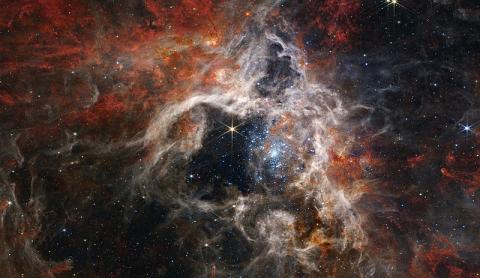
Other evidence for the electrical nature of space includes the filamentary structure of the universe, as can be seen in Figure 1 17 which was predicted by a Nobel-prize winning plasma scientist years before it was discovered.
As stated in the ARJ review:
Scott claimed that plasma theorists predicted the filamentary structure that shows up in galaxy distributions, but the data showing filaments began to appear three decades ago. 6
The clear implication of this statement in the review is that plasma astronomy cannot claim a successful prediction of the filamentary structure of the universe before that filamentary structure was discovered. However, the above statement seems to be in error. Astrophysicists were reported to have been confounded by the universe’s filamentary structure in 1991, though this filamentary structure was predicted 28 years earlier by plasma astronomy:
Alfvén was the first to predict (in 1963) the large scale filamentary structure of the universe, a discovery that confounded astrophysicists in 1991... 18
Hannes Alfvén was a Nobel prize-winning plasma theorist, who was the father of magnetohydrodynamics, as well as the father of plasma astronomy. 19 The ARJ review is dated 2013. "Three decades ago" as quoted from the review, would be 3 decades before 2013, and that would be 1983. This, 1983, is the time when data about the filamentary structure of the universe began to appear per the ARJ review.
So, a plasma theorist did predict filamentary structure two decades before the data began to appear to support the claim according to the review’s own numbers for the appearance of that data!
Using Peratt’s numbers, this would have placed the prediction four decades earlier than the data confirming the prediction.
Either way, the prediction was made decades before it was confirmed.
Also, the ARJ states the data “began" to appear, so this time would not necessarily be when most astronomers believed and accepted the apparent indication of the data; those astronomers would likely have waited for more data to confirm the earlier data, before accepting what it indicated (a filamentary structure of the cosmos). Thus, the time frame when astronomers finally accepted the filamentary structure was likely even later than the date when data first began to appear, making the delay from prediction to acceptance even longer than the multiple decades established above, and making the earlier prediction of plasma astronomers even more amazing and significant.
Cosmic Electric Currents
No electromagnetic effects at cosmological scales?
Contrary to the claim of the ARJ review that (emphasis added)
“appreciable net charges can affect lab scales, but they cannot on galactic and cosmological scales,”
electric currents have been found at very large scales, even thousands of light years long - galactic and cosmological scales.
Evidence of large scale, “galactic-dimension,” electric currents (certainly far, far beyond the laboratory scale to which the review limits astronomical electric phenomena) are also described by Peratt:
The observational evidence for galactic-dimension Birkeland currents is given based on the comparison of the synchrotron radiation properties of simulated currents to those of extra-galactic sources. 20
Also, Contopoulos reported further evidence contradicting the review’s statement, namely that charges cannot affect “galactic and cosmological scales” (emphasis added):
Astrophysical black holes and their surrounding accretion disks are believed to be threaded by grand design helical magnetic fields. There is strong theoretical evidence that the main driver of their winds and jets is the Lorentz force generated by these fields and their associated electric currents. Several researchers have reported direct evidence for large scale electric currents along astrophysical jets. 21
Active galactic nuclei (AGN ) jets are now being found to be composed of electric currents (emphasis added):
However, our results have now yielded firm evidence that many—possibly all—AGN jets have inward currents along their axes and outward currents in a more extended region surrounding the jets.... It also indicates that astrophysical jets are fundamentally electromagnetic structures... 22
New Scientist reported in 2011 regarding a paper by Philip Kronberg et al. (emphasis added):
A COSMIC jet 2 billion light years away is carrying the highest electric current ever seen: 1018 amps, equivalent to a trillion bolts of lightning. 10
Kronberg, of the University of Toronto, and colleagues measured the alignment of radio waves around a galaxy called 3C303, which has a giant jet of matter shooting from its core. 23 They saw a sudden change in the waves’ alignment coinciding with the jet. “‘This is an unambiguous signature of a current,’ says Kronberg.” 10
The team thinks magnetic fields from a colossal black hole at the galaxy’s core are generating the current, which is powerful enough to light up the jet and drive it through interstellar gases out to a distance of about 150,000 light years. Accordingly, from Kronberg (emphasis added):
...this 50 kpc 24 long jet. ...a direct determination of a galactic-scale electric current (∼3 X 10¹⁸ A), and its direction—{positive} away from the AGN. 23
Thus, it has been shown that indeed, it is possible for electric currents to travel through the vacuum of space. These currents are electromagnetic structures known as Birkeland currents that maintain their structure in the interstellar and intergalactic medium of space without dissipation over even thousands of light years of distance, due to the recently elaborated interplay of electromagnetic forces that “squeeze” the current, minimizing dissipation and maintaining the current. These forces are described by Don Scott. 13
Kronberg’s finding also relates to the assertion that electromagnetic forces cannot have effects on a cosmological scale. 6 Indeed, the evidence tells us that electromagnetic forces can and indeed do have effects on such a cosmological scale! Obviously, “thousands of light years” is well beyond the laboratory scale.
In light of the evidence provided, we see the ARJ review fails to accurately depict the true situation with regard to electrical neutrality in space. This claim, regarding electrical neutrality, is just one of multiple questionable claims and conclusions of the review. Therefore, we need to reevaluate and question the conclusions of the review before rejecting plasma astronomy.
There is a practical consideration to this; this does not mean we should accept every theory in existence! For example, the theory that pink elephants on the Moon cause tornadoes in Kansas need not be taken too seriously. But, if the theory is not ridiculous, and is supported by the work of a Nobel laureate (as is the case with plasma astronomy) - that is different!
Is it ok to question the claims of a published review? We ought to consider that the ARJ review itself is questioning the plasma science claims of a PhD university professor emeritus, as well as those of a Nobel prize winner. It is good to question science - peer review, and the recommended approach to science itself (replication of experiments, for example), include such questioning.
In general, regarding the practice of science, we ought to question scientific claims in general, including even questioning claims made here, in this article itself! In science, evidence should trump claims.
For more information on electric currents in space, the reader is referred to the videos below, https://youtu.be/fe0jgBqWjKI and to https://www.youtube.com/watch?v=cO79mMx6Ieg.
Conclusion
We have seen evidence for several points:
- Many arguments against plasma astronomy that may seem valid on first hearing them are found to be invalid upon closer examination.
- In conventional astronomy, gravitational effects in many cases have been invoked, while electromagnetic/plasma effects have been ignored, such as in the case of galactic rotation curves. Why not consider electromagnetic effects too? They should be considered!
- There is evidence for electromagnetic phenomena in space, in particular for electric currents.
- Conventional astronomy has sometimes - erroneously - denied the existence of such evidence for electromagnetic phenomena, in particular for the existence of electric charges and currents.
It seems that the more we learn, the more evidence in support of plasma astronomy we find.
Too quick rejection of plasma astronomy can lead to rejection of other theories depending on or incorporating plasma astronomy. This could be a serious impediment to progress in further research in cosmology as well as in creation/origins science. Plasma science should therefore not be rejected out of hand, and instead should be seen as a valid and fertile field of science for origins research.
- 1(2022 Aug) Faster than Light - Part 2. https://cosmos.creation-controversy.com/article/faster-light-part-2 Creation Cosmology website
- 2(2021 Mar) Does Changing Speed of Light Violate Energy Conservation? https://cosmos.creation-controversy.com/article/does-changing-speed-light-violate-energy-conservation Creation Cosmology website
- 3(2022 May) Faster than Light - Part 1. https://cosmos.creation-controversy.com/article/faster-light-part-1 Creation Cosmology website
- 4For more information on Setterfield’s cosmology, see Setterfield https://tasc-creationscience.org/article-topics/setterfield Accessed 2023 Jan 26
- 5 a b (2022 Nov) Plasma Astronomy: A Different View - Part 1. https://cosmos.creation-controversy.com/article/plasma-astronomy-different-view-part-1 Creation Cosmology website
- 6 a b c d e f g h Faulkner DR (2013) An evaluation of plasma astronomy. Answers Res. J. 6:303–320. https://assets.answersingenesis.org/doc/articles/pdf-versions/arj/v6/evaluation-plasma-astronomy.pdf Accessed 2023 Jan 17
- 7Scott DE (2006) The Electric Sky: A Challenge to the Myths of Modern Astronomy, Mikamar, Portland
- 8Scott DE (2009 Mar 16) Plasma physics’ answer to new cosmological questions. https://www.youtube.com/watch?v=oUDzd5GJ-6E
- 9 a b Peratt AL (2015) Physics of the Plasma Universe, 2nd ed., Springer, New York, 17–19
- 10 a b c News Staff (2011 Jun 15) Universe's highest electric current found. New Scientist. https://www.newscientist.com/article/mg21028174-900-universes-highest-electric-current-found/ Accessed 2023 Jan 20
- 11The plasma explanation does NOT produce puzzles that need to be solved by invoking undetected (dark) matter, nor by proposing changes to Newton's laws of motion (MOND). This means it is a better explanation, per Occam's razor.
- 12There is not space to go into all of these mechanisms in detail, but more information can be found in these sources:
https://www.plasma-universe.com/Mark-lund-convection/,
https://en.wikipedia.org//wiki/Z-pinch,
https://www.plasma-universe.com/birkeland-current/ Accessed 2023 Jan 26 - 13 a b Scott DE (2015) Birkeland currents: A force-free field-aligned model. Prog. Physics 11(2): 167–179. http://fs.unm.edu/PiP-2015-02.pdf Accessed 2023 Jan 17
- 14Anthony Peratt. Wikipedia. https://en.wikipedia.org/wiki/Anthony_Peratt Accessed 2023 Jan 23
- 15Peratt AL (1995) Plasma and the universe: large scale dynamics, filamentation, and radiation. Astrophys. Space Sci. 227: 97–107. https://doi.org/10.1007/BF00678070 Accessed 2023 Jan 22
- 16Setterfield BJ, Setterfield HJ (2013) Cosmology and the Zero Point Energy, Natural Philosophy Alliance Monograph Series, 205 Available from https://www.barrysetterfield.org/GSRdvds.html#cosmology
- 17NASA, ESA, CSA, STScI, Webb ERO Production Team, Public domain, via Wikimedia Commons https://commons.wikimedia.org/wiki/File:Tarantula_Nebula_by_JWST.jpg
- 18Peratt AL (1988 May) Hannes Alfvén: Dean of the Plasma Dissidents, The World & I Online, 190–197 https://plasmauniverse.info/downloads/DeanOfPlasma.pdf . Also, Hannes Alfvén (1908-1995), https://plasmauniverse.info/people/alfven.html Accessed 2023 Jan 17
- 19The Nobel Prize in Physics 1970 Hannes Alfvén – Facts. NobelPrize.org. Nobel Prize Outreach AB 2023. https://www.nobelprize.org/prizes/physics/1970/alfven/facts/ Accessed 2023 Jan 10
- 20Peratt AL (1999) The evidence for electrical currents in cosmic plasma. IEEE Trans. Plasma Sci. 18(1):26–32.
- 21Contopoulos I (2017) Electric currents along astrophysical jets. Galaxies 5(4):71. https://www.mdpi.com/2075-4434/5/4/71 Accessed 2023 Jan 18
- 22Gabuzda DC, Nagle M, Roche N (2017) The jets of AGN as giant coaxial cables. Astron. Astrophys. manuscript no. Gabuzda-AA-Dec2017. https://arxiv.org/pdf/1712.08414.pdf Accessed 2023 Jan 18
- 23 a b Kronberg PP, Lovelace RVE, Lapenta G, Colgate SA (2011) Measurement of the electric current in a Kpc-scale jet. Astrophys. J. Let. 741:L15 DOI 10.1088/2041-8205/741/1/L15 https://arxiv.org/pdf/1106.1397.pdf Accessed 2023 Jan 26
- 24kpc is the abbreviation for kiloparsec. A parsec is ~3.26 light years, so the jet mentioned would be over 150,000 light years long!

- Log in to post comments