
Reviewing An Option Presented by JWST Images
State
Files
| Attachment | Size |
|---|---|
| PDF original article | 994.35 KB |
Reviewing An Option Presented by JWST Images
Citation: Barry Setterfield (2023) Reviewing An Option Presented by JWST Images. Journal of Physics & Optics Sciences. SRC/JPSOS/250. DOI: https://doi.org/10.47363/JPSOS/2023(5)203
Received: September 11, 2023; Accepted: September 13, 2023; Published: September 20, 2023
Copyright: ©2023 Barry Setterfield. This is an open-access article distributed under the terms of the Creative Commons Attribution License, which permits unrestricted use, distribution, and reproduction in any medium, provided the original author and source are credited.
Barry Setterfield Independent Researcher, Oregon, USA
*Corresponding author Barry Setterfield, Independent Researcher, Oregon, USA.
ABSTRACT
Recent images from the James Webb Space Telescope (JWST) of objects thought to be near the origin of the cosmos show complete, full-sized, massive, brilliant galaxies. However, standard astronomy, based on gravitational interactions, had suggested that full galaxies would take about one to two billion years to form. While some of these JWST data need verification or are disputed, there is the perception that we may be facing a crisis in cosmology. While some are doing their best to save the standard approach, others have suggested that a new approach to galaxy formation and cosmology may be needed. If this suggestion is followed through, it is possible that plasma physics applied to astronomy might, potentially, have some answers. That possibility is briefly explored here.
Note: Plasma Physics, Plasma Astronomy, Plasma Universe and Plasma Cosmology should not be confused with, and are entirely separate from, the Electric Universe group and its Holoscience.
Introducing the Problem
The images from the James Webb Space Telescope accentuate some long-standing problems in astronomy. These problems are proving difficult to deal with using the current consensus model based on gravitational interactions. Because of this model, what many seemed to expect from the JWST were images of clumps of material coming together to form larger objects that would eventually coalesce to form full or complete galaxies. Indeed, in August 2023, Adam Mann in assessing this approach concluded by saying: “Most models estimate that a galaxy the size of our Milky Way wouldn’t form until roughly 1 billion to 2 billion years after the Big Bang” 1 Since the JWST was viewing epochs earlier than that, full or complete galaxies were not really expected.
Instead of this expectation being realized, Adam Mann went on to point out that the “JWST observations showed staggering numbers of [complete] galaxies potentially existing as early as 180 million years after the Big Bang”. 1 Indeed, a Science News summary of the JWST data in August 2023 said that “Galaxies in the early universe were bigger, brighter and more mature than expected”. 2 Furthermore, the JWST found elements in stars within those galaxies that show an equivalent of 1 billion years of burning, yet they are not even 500 million years from the Big Bang. 3 “No one was expecting anything like this”, says Michael Boylan-Kolchin of the University of Texas, Austin. 4 “Galaxies are exploding out of the woodwork,” says Rachel Somerville of the Flatiron Institute. 4 “This is way outside the box of what models were predicting,” says Garth Illingworth of the University of California (UC), Santa Cruz. 4 As a result, astronomers and cosmologists are facing a crisis. In September 2023, Michael Boylan-Kolchin affirmed that, if these data are correct, “we’ll require something very new about galaxy formation, or a modification to cosmology”. 5
The Problem of Time
One key part of the problem that arises from these JWST images is a matter that has been stalking astronomers for some time, and is now becoming critical. The problem is basically the formation time of astronomical objects on the standard gravitational model. Three examples must suffice. First, gravitational forces on particles are so weak that it takes 1000 million years or more to form full galaxies. 1 The JWST images have made this problem much worse. They have shown that fully formed galaxies exist so close to the inception of the cosmos that it seems virtually impossible to form by gravity on any model; there simply is not enough time.
Second, the formation of elements and their distribution throughout a galaxy is dependent on several generations of “cooking” by nuclear processes inside stars which then explode the elements out into space at the end of their life. This takes a significant time on consensus theory. In contrast to this, the JWST results show that the elements oxygen and neon are already present in the earliest galaxies. 6 This problem was amplified in July 2023 by the discovery by Wistok et al. of carbon in these early galaxies. 7 As pointed out by Robert Lea, these findings challenge conventional theory “as some of the galaxies they saw the PAH [carbon] dust in are estimated to be somewhere in the region of 10 million years old. That implies there must be a creation and dispersal method for carbon that works on a relatively short time scale”. 8 So, again, a time problem exists.
A third, yet persistent, time-problem was mentioned much earlier by James Trefil, Professor of Physics, George Mason University, Fairfax, Virginia. He writes: “Can the gravitational forces act quickly enough after [atom formation] occurs to gather matter into galaxy-sized clumps before the Hubble expansion [of the universe] carries everything out of range? ....There is a narrow window of time between [atom formation] and the point where matter is too thinly spread, and any galaxy-formation [model] we can accept has to work quickly enough to fit into this window.” He pointed out that current models do not do that. 9
So, in keeping with the comment by Michael Boylan-Kolchin that “we’ll require something very new about galaxy formation or a modification to cosmology”, a different view about galaxy formation may be emerging, which is in keeping with these JWST data and BB concepts. 5 This view by-passes the time-problem, caused by the gravitational approach, by concentrating, initially, on lab experiments with plasma filaments and their electromagnetic interaction. When the results of these experiments and simulations are up-scaled to the size of actual galaxies in the universe, a new cosmology seems possible in which all the problems mentioned above are overcome. Let us briefly review this option.
Introduction to Plasma
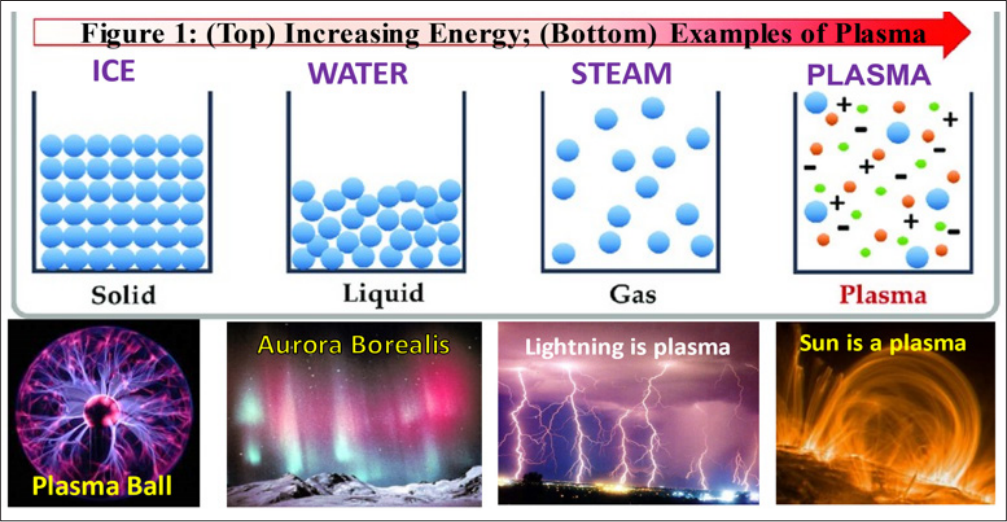
Scientists and professionals from other disciplines, including Medicine, have a different usage of the word “plasma.” Therefore, it might be wise to point out that, in physics and related sciences, the word “plasma” describes the 4th state of matter after solid, liquid and gas. When a gas is heated or energy is supplied, the atoms making up the gas dissociate into their component parts so that negative electrons and positive ions or protons wander around independently of each other. This is the state of plasma (See Figure 1 top row).
Because of the high energies involved with the Big Bang process, all matter was in the form of plasma initially. However, even today, the situation is not very different, since the Plasma Science and Fusion Center of the Massachusetts Institute of Technology points out that over 99% of the visible universe is still in the form of plasma. They go on to say that “in the night sky, plasma glows in the form of stars, nebulas, and even the auroras that sometimes ripple above the north and south poles. That branch of lightning that cracks the sky is plasma, so are the neon signs along our city streets. And so is our sun, the star that makes life on earth possible” (See Figure 1 bottom row). 10
There is another aspect to this that is not often realized. As Trefil’s statement notes, gravitational interactions are really only effective once neutral atoms have formed. 9 To understand why, consider this comment by physicists working at Los Alamos National Laboratories. They state that, out in the cosmic environment, “Even weakly ionized plasma reacts strongly to electromagnetic fields since the ratio of the electromagnetic force to the gravitational force is 39 orders of magnitude”. 11 It seems to go even further. After high resolution processing of data from about 2000 clouds of “neutral hydrogen” in our galaxy, radio astronomer Gerrit Verschuur found they were actually made up of plasma filaments. These filaments twisted and wound like helices over distances averaging about 330 light years long carrying electric currents of about 1.4 x 10¹³ amperes. 12 These data were in line with results obtained by others and showed that even though ionization may be as low as 1 part in 10,000, electromagnetism could still be 107 times stronger than gravity. 11 13
This leads back to Trefil’s conclusion that gravity can only start to act and draw matter together once neutral atoms have formed. However, from the foregoing discussion, it emerges that, if galaxies, stars and planets formed by plasma processes, those processes could start acting on plasma almost at once after the initial Big Bang moment. Just what those processes may be, we must now discover.
Important Plasma Characteristics
Let us begin simply so scientists from other disciplines may be brought up to speed on this. In a toy plasma ball, in the lab, and also out in space, plasma typically forms in filaments or sheets. There is a reason for this. The movement of charged particles, whether protons, ions or electrons, is what constitutes an electric current. So, in dealing with plasma, we are also dealing with electric currents due to the motion of charged particles or ions. It is important to realize that all electric currents have a circling magnetic field. This can be demonstrated in the lab by a simple circuit, composed of a wire with a switch, connected to a battery, and a compass needle. When the switch is closed and the current flows, the compass needle deflects. In the case of plasma, the circling magnetic field is the result of the electric current which is the flow of charged particles. This circling magnetic field then constrains the plasma to form into filamentary structures both in the lab and in space.
Knowing these effects in the lab and our stellar neighborhood, plasma pioneer and Nobelist, Hannes Alfven, predicted in a Conference presentation in 1961 that the large-scale structure of the whole universe would prove to be filamentary as well. 14 To the consternation of many astronomers, this was proven correct in 1991. The research team involved stated that they had found superclusters of galaxies along filaments hundreds of millions of light years long, surrounded by voids. 15 This indicated the structure of the cosmos may be filamentary, at least out to medium distances. This fact was difficult to account for using a gravitational mechanism, but by imposing special conditions it was eventually replicated on computers.
Then, in 2006, an international team undertook an analysis of galaxies in the Sloan Digital Sky Survey. They found that the spin axes of spiral galaxies were aligned along the filament they were mutually embedded in. This conclusion had a 99.7% confidence level. 16 Another astronomer summarized by saying that “the international team found that spiral galaxies, like the Milky Way, line up like beads on a string, with their spin axes aligned with the filaments that outline voids”. 17 This was a definite problem gravitationally, even though it would be a natural consequence of a plasma origin. Yet that is not all. In 2014, Dr Damien Hutsemekers of the University of Liege in Belgium used the Very Large Telescope in Chile to observe 93 quasars that were spread over billions of lightyears. Hutsemekers commented: “The first odd thing we noticed was that some of the quasars’ spin axes were aligned with each other – despite the fact that these quasars are separated by billions of light-years”. 18 They found that the spin axes of the quasars and their polar jets were linked not just to each other, but also tended to be parallel to the large-scale filaments that they were part of. Diagrams, comments and further information is in reference. 19
So, even at the largest scales in the cosmos, a plasma/filamentary origin for galaxies seems to be a reasonable proposition since, unlike the gravitational model, no fine-tuning is required. This suggests that plasma astronomy may provide an answer to at least some of the problems we started with.
A Potential Answer to the Problem?
In the lab, if two parallel wires are carrying electric currents in the same direction, it is found that the circling magnetic fields around those wires act in such a way as to draw those wires together. In contrast, if the electric currents are moving in opposite directions, the magnetic fields act so that the wires are repelled. The same is true for plasma filaments; two or more filaments will be attracted to each other if the electric current is flowing in the same direction. This is equally true for plasmas anywhere, whether in space or in the lab. Los Alamos National Labs had a Senior Staff Member whose speciality was laboratory and space plasmas. This scientist was Dr. Anthony Peratt.
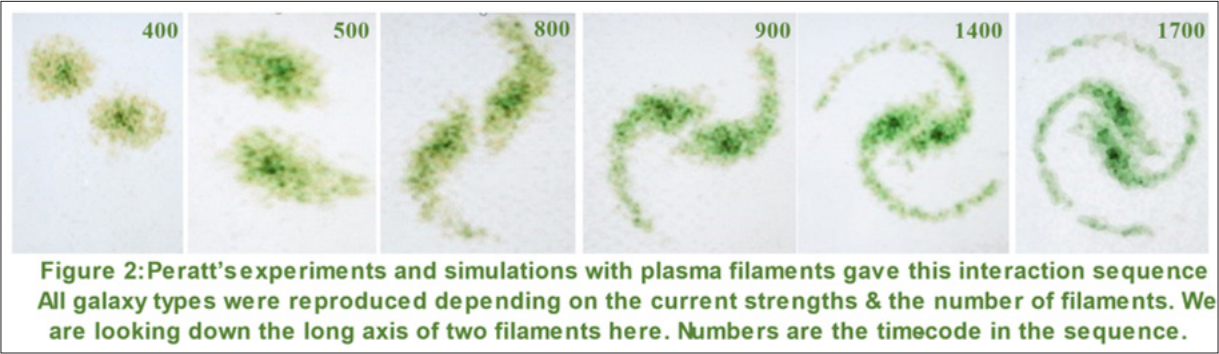
Knowing the ubiquitous nature of plasma filaments, Dr Peratt experimented with plasma in the lab. He recorded plasma behavior, including emission of various types of radiation, using time-streak and framing cameras, special pin-hole X-ray cameras, laser shadowgraphy, ion probes and other types of equipment. The results of the interaction of two or more plasma filaments in the lab, which formed miniature galaxies, were recorded in reference. 20 His updated conclusions were published in his book “Physics of the Plasma Universe,” (Springer, 2015). A typical example of what was happening with these filament interactions in the experiments is given here in Figure 2. Note that, out in space, but unseen in this lab sequence, intergalactic plasma will be trapped between the filaments by their magnetic fields. Also, as the two filaments approach, the intensifying magnetic field pinches and concentrates the plasma and collapses it into the forms seen here and explained further below. The resulting disk-like structures have proportions that correspond to the various galaxies in the cosmos.
Lab results and Galaxies in Space
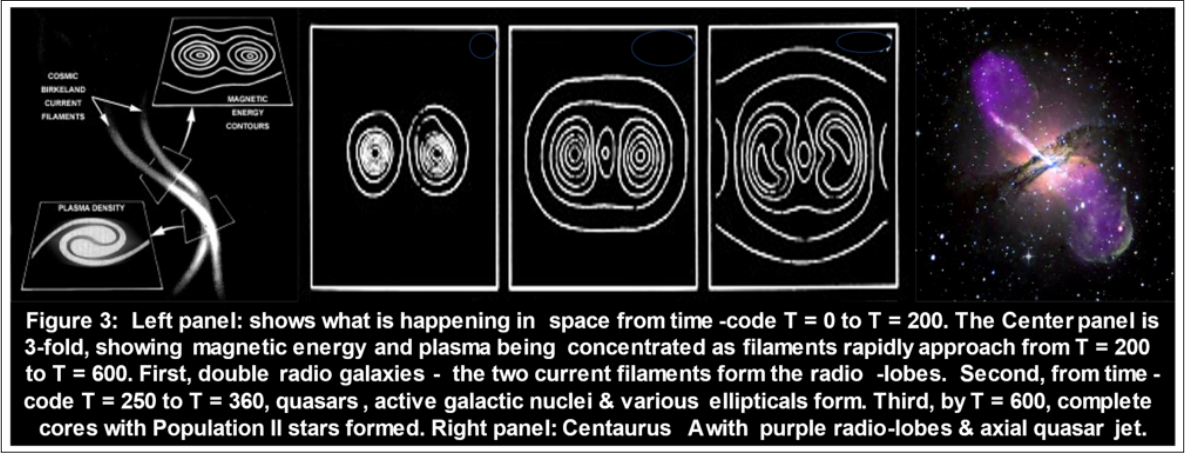
The sequence of events in the lab was important as, observationally, it paralleled what was occurring with actual galaxies out in the universe. The initial situation as the filaments started to approach and then began their interaction, from time-code T = 0 to T = 200, is sketched in the left panel of Figure 3. The 3-fold center panel shows the development that occurs as magnetic field energy is concentrated by the rapidly approaching current filaments through T = 200 to T = 600, and the plasma between the two filaments becomes concentrated as a result. First, double radio galaxies form, with the two current filaments forming the radio lobes on either side of the core. Second, as the interaction goes on and filaments approach more closely, quasars and active galactic nuclei form, which are then followed by the various types of elliptical galaxies between time-codes of T = 250 and T = 360. 21 Third, as the interaction went on, the complete cores of the miniature galaxies had fully formed, along with the “old” or Population II stars by T = 600. 22 By way of illustration in Figure 3, the right-hand panel shows Centaurus A with the purple radio-lobes, and axial quasar jet.
All these steps in the lab were confirmed by the type of radiation emitted, the measured magnetic field energy, and the optical results.
From about T = 700 to T = 800, the miniature spiral arms started to emerge out of the core and began extending. 23 These spiral arms were then present and lengthening from T = 1000 to T = 1100. Peratt commented: “the spirals arms grow in length as they trail out along the magnetic isobars. …Because of the lengthening of the arms and their thinning… the axial current conducted through the plasma arms produces a diocotron instability [so that] the stars in the spiral arms appear like beads on a string”. 23 These “young” or Population I stars were forming in the spiral arms from T = 1200 to T = 1700. 24 The whole galaxy is complete between T = 1750 and T = 2500 depending on the number of filaments interacting and the individual current strengths. 25
Three Questions:
Three points remain to be discussed. First, the question as to why there is a difference between normal spiral galaxies and barred spirals. Peratt had determined the conditions from lab experiments as to whether barred or normal spirals would form out of the plasma interaction. He stated that “it depends primarily on the profile or cross section of the current-carrying filaments, its density distribution, and strength of the azimuthal magnetic fields. Bars form when the interacting plasma regions are sharply divided in plasma density, while normal spirals tend to form when the intergalactic plasma supporting the current-conducting filaments is more homogeneous overall”. 26
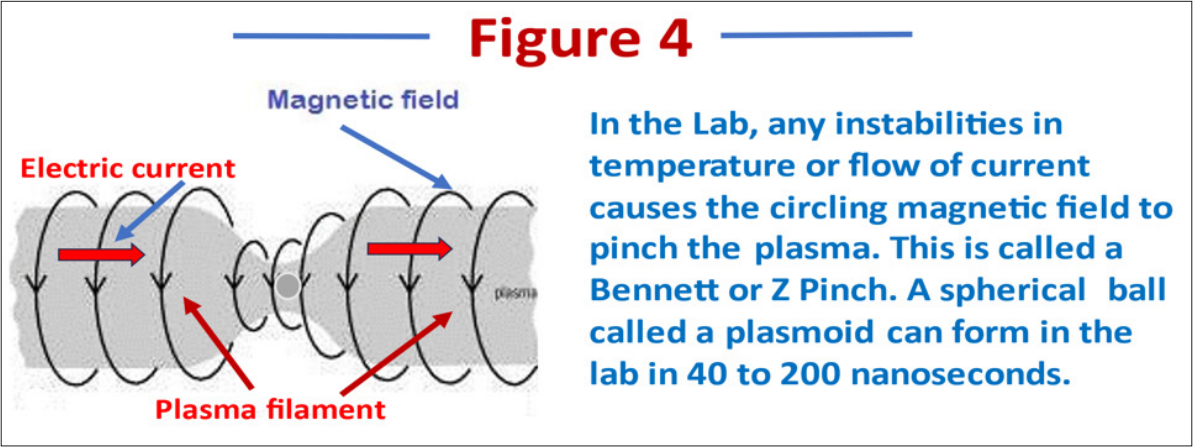
Second, the question as to how star form has an answer in a precise plasma mechanism. Simply put, stars are formed as a result of plasma instabilities. In lesser plasma filaments within a galaxy, any variation in current flow or temperature causes an instability in the circling magnetic field which then suddenly pinches in. This causes all the plasma in that region to be compressed into a ball. It is sometimes called a “Bennett pinch” or Z-pinch and is shown in Figure 4.
Third, is the question which is directly related to the problem of the timing of galaxy formation posed by the JWST results. It is here that Peratt’s laboratory interaction time-codes, T, are very helpful. Here we find specifically that he defined what he calls a “timestep,” T, in miniature galaxy formation, where T = 0.000104 seconds (that is 1.04 x 10⁻⁴ seconds). He then noted that to upscale these lab results to actual astronomical phenomena in real time, the value of T had to be multiplied by a factor of 5.87 x 10¹¹ to give the answer in seconds. This factor was determined by comparing the physical parameters of what he was seeing in the lab with what was actually happening in real time with objects in space and was detailed on pages 645 - 650 where the upscaling factor was derived in. 27
When the above figures are employed, the following results emerge.
- Complete galaxy cores with their Population II stars had formed by T = 600, When this is multiplied by the conversion factor of (5.87 x 10¹¹) we get a time of 3.522 x 10¹⁴ seconds or 11.16 million years for this to happen by plasma physics in the real universe.
- Full spiral galaxies were complete with spiral arms and Population I stars around T = 1750 up to T = 2500. When this is multiplied by the conversion factor, and the resulting answer in seconds is then converted to years, the result is that plasma astronomy indicates that full galaxies may have formed some 32.55 million years to 46.5 million years after the Big Bang.
Conclusion
If plasma physics is applied to astronomy, then at least it offers the possibility that fully formed galaxies may have existed some 50 million years after the Big Bang. If so, then this would overcome the potential time problem that astronomy may face with the results of the JWST. It was suggested that we may be able to see back to 180 million years after the inception of the universe with the JWST. 1 If this proves to be so, plasma astronomy suggests we might still see some fully formed galaxies there. These lab results thereby introduce a new cosmology consistent with both a Big Bang approach and the amazing James Webb Space Telescope images from the very early universe.
References
- 1 a b c d Mann A (2023) The James Webb Space Telescope prompts a rethink of how galaxies form. Proceedings of the National Academy of Sciences 120: e2311963120.
- 2Grossman L (2023) JWST’s hunt for distant galaxies keeps turning up surprises. Science News https://www.sciencenews.org/article/jwst-distant-galaxies-surprises-space.
- 3Ariana Remmel (2022) What the first James Webb Space Telescope images could mean for chemistry. Astrochemistry 100. https://cen.acs.org/physical-chemistry/astrochemistry/first-James-Webb-Space-Telescope/100/i25
- 4 a b c Cleary D (2022) Webb telescope reveals unpredicted bounty of bright galaxies in early universe. Science 377: 700-701.
- 5 a b Talcott R (2023) Too Big, Too Soon. Astronomy: 26-27.
- 6(2022) Webb's First Deep Field (NIRSpec Emission Spectrum) https://webbtelescope.org/contents/media/images/2022/035/01G7F33FYJY94B9H7FW1APV030
- 7Witstok J, Shivaei I, Smit R, Roberto M, Stefano C, et al. (2023) Carbonaceous dust grains seen in the first billion years of cosmic time. Nature (2023). https://doi.org/10.1038/s41586-023-06413-w
- 8Lea R (2023) James Webb Space Telescope makes 1st detection of diamond-like carbon dust in the universe's earliest stars. Science & Astronomy. https://www.space.com/jameswebb-space-telescope-1st-detection-of-diamond-like-carbondust-earliest-stars
- 9 a b Trefil J (1988) The Dark Side of the Universe, Chapter 4:Five reasons why galaxies can’t exist: 55.
- 10(2023) What is Plasma? Plasma Science and Fusion Center https://www.psfc.mit.edu/vision/what_is_plasma
- 11 a b Peratt AL (1992) Physics of the Plasma Universe. Springer: 17.
- 12Verschuur G (1995) Interstellar neutral hydrogen filaments at high galactic latitudes and the bennett pinch. Astrophysics & Space Science 227: 187-198.
- 13Carlqvist P, Gahm GF (1992) Manifestations of electric currents in interstellar molecular clouds. IEEE Transactions on Plasma Science 20: 867.
- 14Alfven H (1961) Proceedings of IAU Symposium no. 16 held at Cloudcroft, New Mexico, U.S.A: 28-30. Evans JW (1963) International Astronomical Union. Symposium no. 16, Academic Press, New York: 35.
- 15West MJ, Villumsen VL, Dekel A (1991) Filamentary superclustering in a universe dominated by cold dark matter. Astrophysical Journal 369: 287-299.
- 16Trujillo I, Carretero C, Patiri SG (2006) Detection of the Effect of Cosmological Large-Scale Structure on the Orientation of Galaxies. Astrophysical Journal Letters 640: L111-L114.
- 17Adler R (2006) Galaxies like necklace beads. Astronomy https://www.astronomy.com/science/galaxies-like-necklacebeads/
- 18Hutsemekers D, Braibant L, Pelgrims V, Sluse D (2014) Alignment of quasar polarizations with large-scale structures. A&A. 572: A18.
- 19(2014) Mysterious Alignment of Quasar Axes with Universe’s Large-Scale Structures Revealed https://www.sci.news/astronomy/science-alignment-quasar-axes-large-scale-structures-02285.html https://www.dailymail.co.uk/sciencetech/article-2842418/Mystery-spooky-pattern-universe-Scientists-supermassive-black-holes-aligned.html
- 20Peratt AL (1986) Physics of the Plasma Universe. IEEE Transactions on Plasma Science 14: Part 1: 639-660 & Part 2: 763-778.
- 21Peratt AL (1986) Physics of the Plasma Universe. IEEE Transactions on Plasma Science 14: Part 1: 639-660 & Part 2: 648, 650, 765, 766.
- 22Peratt AL (1992) Physics of the Plasma Universe. Springer 1st Edition: 120 op cit: 766, 768.
- 23 a b Peratt AL (2020) IEEE Transactions on Plasma Science 14: 767-777.
- 24Peratt AL, Ibid (1992) Physics of the Plasma Universe. Springer 1st Edition: 120.
- 25Peratt AL (1986) IEEE Transactions on Plasma Science 14: 767-777.
- 26Peratt AL (1986) IEEE Transactions on Plasma Science 14: 768.
- 27Peratt AL (1986) Physics of the Plasma Universe. IEEE Transactions on Plasma Science 14: Part 1: 639-660 & Part 2: 763-778.