
Does Supernova SN1987A disprove faster light speed in the past?
State
NOTE on terminology: CDK implies that light was faster in the past, and then over time, gradually decayed. So, CDK refers to the De-Kay (decay) of C (the speed of light): CDK.
The light originating from supernova SN1987A and the reflection of this light from a gas cloud have been used in a calculation, dividing the distance between the gas cloud and the supernova by the time between the arrival on earth of light from these 2 sources. The claim is that the result (distance / time) is the velocity of light as it traveled between the gas cloud and the supernova; and further, the claim is that this calculated value would be the speed of light in the past, since light traveled between those objects in the past. Since the calculated result matches the current speed of light, the claim is that light speed in the past was the same as its speed now, not faster, and that this calculation refutes CDK.
However, this reasoning above is not valid! There are implicit assumptions, not all of which are valid. In effect, what was calculated was not the speed of light in the past, but the current modern speed of light. So, the result tells us nothing about the speed of light in the past. This is shown below.
Back to top1) The (invalid) claim
First, the invalid argument claims, regarding a supernova discovered in 1987:
... only a small fraction of the light from this explosion was directed toward the earth. Some light went off in other directions and reflected off of the surrounding gas which then redirected the light toward earth – a “light echo.” This light arrived after 1987 because it took time to go from the supernova to the surrounding gas. By measuring the distance between the supernova and the surrounding gas, and dividing by the time between the two events, we can compute the speed of light when the supernova happened. And we find it is consistent with the current value of c ... 1
The statement that "By measuring the distance between the supernova and the surrounding gas, and dividing by the time between the two events, we can compute the speed of light when the supernova happened," is false. What this process calculates is the speed at which light traveled in modern times - 1987 or later - not the speed at which light traveled in the past!
The important point here is that the calculated result is also consistent with CDK! And, that calculated result is not the speed at which light traveled in the past - rather, that calculation is of the modern, 1987 or later, speed of light.
The calculation is based on implicit assumptions which are not valid.
Back to top2) Implicit assumptions
We shall see below that there is an assumption that the calculated speed is that of light that traveled in the past. Also there is an assumption that the calculated speed was that of light while traveling from the supernova to the gas cloud. We shall demonstrate below that both these assumptions are not valid.
2.1) Crucial aspect
This may not be obvious, but the crucial aspect is that, if one assumes that light speed did change in the past with respect to time, but NOT with respect to location, then one can easily refute the above argument against CDK. A key point in what follows is that per CDK, at least the version of CDK examined in this short article, light speed (c) did decay over time, but did not vary over space. At a single instant of time, light speed was the same throughout the universe - at that instant of time. At a later instant of time, light speed could be different than it was at the previous instant - but, at any single instant of time, light speed is the same throughout the universe.
This may become clearer by thinking about the typical usage of the acronym CDK. CDK refers to the change or decay of light speed - over time, not over distance. After all, CDK is typically referred to in the context of different light speeds at different times, not at different locations, as in the speed of light in the ancient past.
Light speed speed could be the same in different locations, at the same time - and then, a different speed at a different time, though the later different speed would have been, at that later time instant, the same in all locations throughout the cosmos.
This assumption is commonly held today by scientists, that the speed of light is the same everywhere, or does not vary due to physical location. 2 CDK does not try to dispute this, just to assert that light speed could have changed over time.
Back to top3) Explanation of invalidity
The calculation in this argument is simple. It is based on 2 paths of light from the supernova. One path is directly from the supernova to earth. This path is path A in Figure 1.
3.1) Image
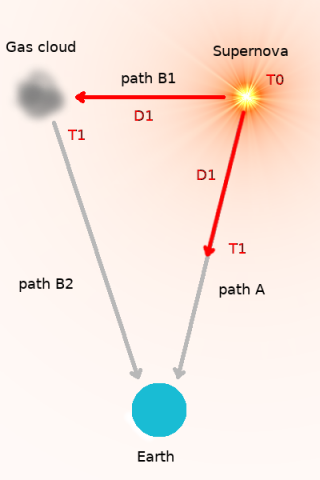
The other path is from the supernova to a cloud of gas, from which the light is reflected to earth. This is path B. Notice that path B is composed of 2 parts: path B1 and path B2.
In the caption to an image in the referenced article, 1 we read the following: (emphasis added)
These light echos show that the speed of light perpendicular to our line of sight was the same at the time and distance of the supernova as here and now. 1
This implies that the distance between the earth and the gas cloud is the same as the distance from the earth to the supernova. 3
This argument takes the time interval between the time of detection of the supernova and the time of detection of light from the gas cloud, and divides that into the distance between the supernova and the gas cloud (path B1) to get the speed of light along path B1. We shall see that this is actually not a measurement of the speed of light along path B1!
Now, of course, it took time for light to travel from the gas cloud to earth (path B2 of Fig. 1). The time used in this calculation was not the time interval between the time point of the supernova explosion and the time point of the appearance of light from the gas cloud on earth; rather, this argument used the time point of the (later!) appearance of light on earth from the supernova in 1987 as the starting point of the time interval used in his calculation.
These were the only two time points used in deriving the time duration used in the calculation as shown in Figure 2:
- the time point of arrival of light on earth from the supernova, T2 (not the actual time of the explosion)
- the time point of arrival of light on earth from the gas cloud, T3
3.2) Key Point
Light travels the same distance along two different paths during the same time interval. This would be true even if the speed of light varied during this time period, as long as the speed varied in the same way along both paths, so that the speed of light was the same on both paths at any specific instant of time. This is the case per CDK. CDK means light speed changes, through (over) time - not throughout space! At any time, the speed of light is the same throughout the cosmos. At a different time, the speed might be different. Therefore the speed of light, even with CDK, is the same at any same specific time, even on different paths. 2
So, in the ensuing analysis, we shall see light traveling differing paths, during the same time period, with the result being that identical distance is covered on both differing paths, during the identically same time period.
3.3) Image
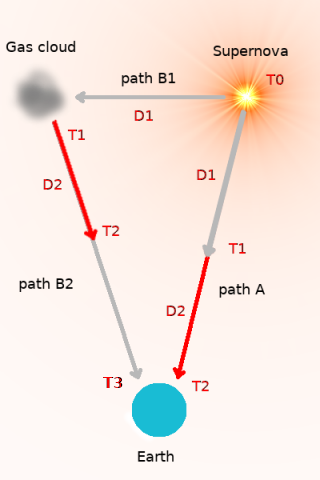
To reiterate, light would decay at the same rate regardless of position or location. CDK is not a function of distance nor of position, but is a function of time. Per CDK, light speed was faster in the past than it is in the present now - that is, light per CDK was faster at a different time than the present - NOT faster in a different place than where earth is now (or any other place, for that matter). This means the speed of light would be the same on all paths in the diagrams in this article, at the same times. Even if light was continuously decaying nonlinearly, the distance covered on any path between two time points (during a specific time period) would be the same as the distance covered on another path during the same time period. This is because changes in light speed happening on one path would also happen on the other path. Light would slow or speed up on both paths in the same manner, since this would be happening over the same time period - even though in different places.
Referring to Fig. 1, we see that at time T0 the supernova exploded. Light then later arrived at the gas cloud at time T1. During this time, from T0 to T1, light not only traveled the distance D1 between the supernova and the gas cloud, but light also traveled the same distance, D1, from the supernova toward earth. The distances D1 on paths B1 and A are equal. They are distances light traveled during the same time period.
Now, consider Figure 2. D2 is the remaining distance along path A to earth directly from the supernova after time point T1. Continuing in time from T1 to T2, light traveled from the gas cloud toward earth (on path B2). The identical time period occurred along path A between time point T1 and time point T2, so the same distance (D2) was covered on both path A and path B2. We noted earlier that the distance to earth from the gas cloud (path B2) and the distance from the supernova to earth (path A) were the same. (Note that the distance D1 + D2 is the length of path A and would also be the length of path B2.)
The distance from the gas cloud to earth is D1 + D2. We see from Figure 3 that light had traveled from the gas cloud distance D2 toward earth at time point T2. Time point T2 is the time at which light coming directly from the supernova appeared on earth.
3.4) Image
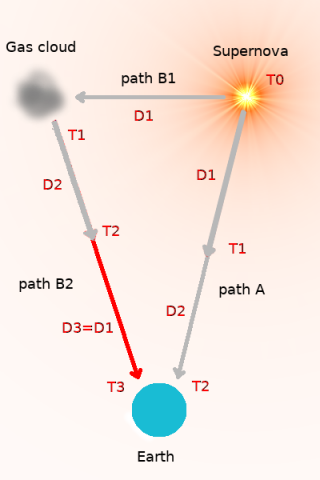
The length of both paths, from supernova to earth and from gas cloud to earth, were the same and equal to D1 + D2. Therefore, at time point T2, the remaining distance for light to travel to earth from the gas cloud, D3, has to equal D1. The time of arrival of light on earth from the gas cloud was T3. This tells us that between T2 and T3, light traveled the distance D1. During this time, light’s speed was the modern value, since T2 is the modern 1987 and T3 was later.
What was calculated was the distance D1 divided by the time interval between T2 and T3. These are the distance and the time that light traveled, respectively, during the time period starting in 1987! There is no wonder that the result was the 1987 speed of light value. This calculation was not the calculation of the speed of light during the ancient past, while light was traveling between the supernova and the gas cloud; it was the calculation of the modern speed of light, during a modern time period.
Back to top4) Another Perspective
This argument against CDK has been refuted. It assumed the time interval between T2 and T3 was the same as the time interval T1, the time that light took to travel between supernova and gas cloud, i.e., the time light took to travel distance D1. We have seen that D1 is ALSO the actual distance that light traveled between T2 and T3; however, that was during modern times, along the path between earth and gas cloud.
Since the distance during time interval T2 - T3 is the same as D1, the distance between supernova and gas cloud, then to assume it took the same time for light to travel that distance in ancient times (between gas cloud and supernova) is to assume the same speed in ancient times, i.e., implicitly assuming what was to be proven, which is logically invalid.
This argument against CDK implicitly assumed distance D3 was the same as D1, which is true. The error was in assuming that the time light took to travel D3 was the same as the time light took to travel D1. This is true only if the speed of light in the past was the modern value. Thus, this calculation implicitly assumed that which was to be proven, which is invalid.
- 1 a b c Lisle J (2020) Distant starlight in a young universe: Attempted solutions. https://biblicalscienceinstitute.com/apologetics/distant-starlight-in-a-young-universe-attempted-solutions/ Accessed 2022 Apr 15
- 2 a b This assumes obvious factors such as traveling through different media with different indices of refraction are not significant or relevant.
- 3Reasonably assuming that path B1 is perpendicular to the path from the mid-point of B1 directly to earth, this means that paths B2 and A would be two equal sides of an isosceles triangle and therefore identical in length. (In Figure 2, moving either the gas cloud or the supernova closer to earth, or further away from earth, results in path B1 no longer being perpendicular to our line of sight.)
Also, the fact that the only distance that was used in the calculation was that of B1, the distance between the supernova and the gas cloud, indicates that the other distances to the earth (paths A and B2) were considered as irrelevant to the calculation, being the same length, and that they cancel out. The fact that the distances A and B2 were not included in the calculation shows that no significant difference in their lengths was assumed.
- Log in to post comments