
Plasma Astronomy: a Different View - Part 1
State

1) Image
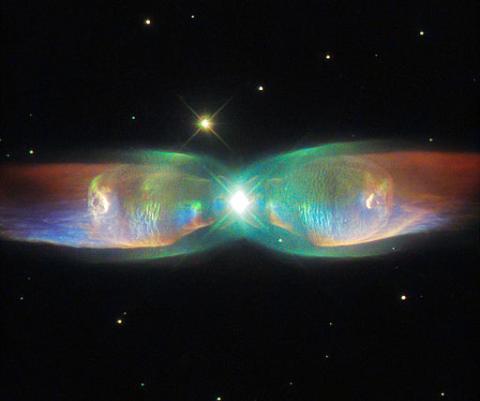
Plasma astronomy has been of interest to some who are interested in the origin of the universe and in how galaxies, stars, and planets formed. Opinions vary on the validity and relevance of plasma astronomy. Astronomers and electrical engineers, in particular, seem to have different views on its validity. In this article we shall look into plasma astronomy and some evidence related to it.
Figure 1 illustrates one example of the impact of plasma phenomena in the cosmos, that is otherwise (without plasma astronomy) more challenging to explain. 1
Back to top1) What is plasma?
First, what is plasma? Plasma is an electromagnetic phenomenon. A plasma is a collection of electrically charged particles. Sometimes plasma has been described as a fourth state of matter, in addition to solid, liquid, and gas. In a gas, the particles (atoms or molecules) are electrically neutral. In a plasma each particle has an electric charge. Thus, electric and magnetic fields come into play and affect the behavior of the plasma. Science has told us that over 99% of the detectable normal (not “dark”) matter in the universe is plasma. We see plasma in lightning, fluorescent lights, neon signs, etc. 2
Back to top2) Relevance to creation
There has been significant effort to consider basic conventional science, such as gravitational theory, in creation science that deals with astronomy and cosmology. For example, general relativity has been applied to starlight and time. 3 Plasma, or we could say electromagnetic science, seems not often mentioned.
It is helpful to have and utilize a basic understanding of relevant physics and science in origins research. This is why basic knowledge of plasma astronomy becomes important. However, there seems to be inadequate understanding in this area, even among scientists, and particularly among astronomers. Therefore, increasing understanding and awareness of plasma phenomena among scientists, especially among origins and creation researchers, seems of obvious value. This is one reason for this article.
Often in science there has been a type of “intellectual inertia” regarding new ideas. 4 The classic example of this is the refusal by those individuals who functioned as vectors of “intellectual inertia” to look through the telescope of Galileo. It is good to have an open mind and be willing to consider something new or different from that with which one is already familiar.
Recent observational and theoretical research have provided much information that lends support to the relevance of plasma astronomy. In this article, I shall examine some of these data. Plasma astronomy concepts provide solutions to some puzzles that are difficult to answer with conventional (largely gravitationally based) astronomy. 5
Let us therefore proceed to “look through” the “plasma astronomy telescope” to see if there is anything significant to be discovered!
Back to top3) Education of astronomers/astrophysicists
One might ask, “Why haven’t conventional astronomers promoted plasma astronomy?” They have acknowledged plasma's existence, but largely ignored the possible impact of its presence. There has been an increasing awareness of electromagnetic phenomena in astronomy, but it has been slow. (Remember the “intellectual inertia” referred to above.) Birkeland posited an electromagnetic explanation for the Northern Lights long ago, which took quite some time to become accepted among astronomers. But finally, it is now generally accepted that the Northern Lights are an electromagnetic phenomenon.
The past historical situation described above with the Northern Lights seems to be the current situation with regard to the modern puzzle of galactic radial rotation velocity gradients, which are the mysterious speeds of rotation of galaxies at various radial distances from their galactic centers. Plasma concepts explain the galactic rotation anomaly without recourse to dark matter, while conventional astronomy has difficulty explaining galactic velocity profiles. The plasma explanation for the galactic rotation anomaly has not been widely accepted yet. Perhaps given more time, it will be. See the section below (Galactic rotation curves) for more on this anomaly.
One factor in astronomy’s slowness to accept electromagnetic explanations seems to be the education of astronomers. Nobel prize winner Hannes Alfvén 6 stated that astrophysics students are not knowledgeable about electromagnetism/plasma (emphasis added):
A study of how a number of the most used textbooks in astrophysics treat important concepts such as double layers, critical velocity, pinch effects, and circuits is made. It is found that students using these textbooks remain essentially ignorant of even the existence of these concepts, despite the fact that some of them have been well known for half a century (e.g., double layers, Langmuir, 1929; pinch effect, Bennet, 1934). 7
Note that the quote above comes from not only the father of magnetohydrodynamics and the acknowledged father of plasma astronomy, but a Nobel prize winner! He knows what he is talking about.
Alfvén pointed out that the plasma concepts that were omitted from textbooks were not new; he said that some had been known for half a century! So there appears to be no reason for not including those concepts in astrophysics textbooks. These concepts are not missing in electrical engineering plasma textbooks. So, why would they be missing in astrophysics textbooks?
Could it be that the plasma concepts were unproven? If they were unproven, they would also be excluded from electrical engineering plasma textbooks, and even more so in engineering texts, since lives may well depend on engineering's being correct! (Consider, for example, the need for correct engineering of a bridge so it will not collapse!)
So, we should expect the electrical engineering plasma textbooks to be even more restrictive about including any unproven concepts than the astrophysics textbooks referred to by Alfvén. But this is not the case; it is in fact quite the opposite!
Not so with astrophysics and cosmology, however, which are more theoretical and without immediate practical impact on health or lives. In astrophysics and cosmology, ideas can be readily discussed and also taught, even without proof. Multiple parallel universes, for example, dark energy, and dark matter, as well as modifications to Newtonian mechanics (MOND), for example, are readily written about and published in astronomical journals, even though the jury is arguably still out for these concepts.
Therefore, any assumption that omitting plasma concepts from astrophysics textbooks was due to their "unproven nature" does not apply, for if it did, electrical engineering plasma textbooks would be even more lacking in these concepts: but they are not!
Also, in college, I noticed that quite often our courses did not cover the entire textbook. And, I note that it has been often stated that college graduates forget much of what they learned within a few years after graduation. To these two factors, we can add a third: that the astronomy/astrophysics textbooks, which were probably not completely covered, were themselves likely incomplete regarding concepts of plasma and electromagnetic physics. This suggests astronomers would know even less about those plasma concepts than is contained in their textbooks, which itself is not much, according to Nobelist Alfvén. The conclusion seems to be, that we cannot conclude with alacrity and certitude that astronomers do indeed know enough to judge the relevance and validity of plasma / electromagnetic concepts in cosmological and astronomical applications. Astronomers may likely, simply not understand plasma astronomy - at least no enough to discount it without learning more about it.
Back to top4) Problems with conventional views in astronomy
Now let’s look at some common ideas and problems found in conventional astronomy (which also provide evidence illustrating the aforementioned typical limited understanding of electromagnetic phenomena by astronomers).
4.1) Galactic rotation curves
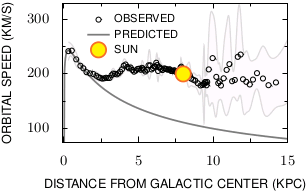
Basic plasma concepts can explain phenomena that puzzle astronomers. One example is galactic rotation curves. These are plots of the speeds of rotation of parts of a large galaxy at different distances from its center. Figure 2 8 illustrates the problem; the rotation speed curve predicted by conventional astronomy, considering gravitation without plasma effects, is not at all what is actually observed. There is not sufficient gravitation from the galaxy to account for the observed rotation curves. Therefore, additional gravitational mass is typically invoked by conventional astronomy. But - where is this additional mass? It is not visible. The stars, planets, etc. cannot account for it. It is invoked, in the form of invisible dark matter.
4.2) Image
But plasma is typically not invoked to explain galactic radial rotation rate gradients. This omission is illustrated by the following:
The rotation curve of a disc galaxy (also called a velocity curve) is a plot of the orbital speeds of visible stars or gas in that galaxy versus their radial distance from that galaxy’s centre. ...A significant discrepancy exists between the experimental curves observed, and a curve derived by applying gravity theory to the matter observed in a galaxy. Theories involving dark matter are the main postulated solutions to account for the variance. 9
Though dark matter is by far the most accepted explanation of the rotation problem, other proposals have been offered with varying degrees of success. Of the possible alternatives, one of the most notable is modified Newtonian dynamics (MOND), which involves modifying the laws of gravity. 9
The word “plasma” did not occur in the Wikipedia article from which the above quote is taken (at the time the article was accessed). Instead of applying the plasma solution, modern astronomers have tended to invoke either dark matter or MOND (MOdified Newtonian Dynamics - changes to Newton’s laws of motion). Both of these attempts appear to be drastic measures, which one would think of as “last resort” mechanisms to be used if and only if there is not any other less drastic explanation available; or, if astronomers were not aware of any less drastic explanations! Modifying Newton’s laws seems somewhat drastic. The other (dark matter) invokes invoking the existence of hypothetical dark matter, “dark” referring to not having been previously detected, which also seems somewhat drastic...
... needlessly drastic. Both these drastic hypotheses are unnecessary. Plasma concepts can and do solve this problem. A quote from the abstract of an article elaborating the plasma explanation of these galactic radial rotation rate gradients is below (emphasis added):
[The plasma model] shows that observed stellar velocity profiles in galaxies are now accurately predicted without invocations of Dark Matter. 10
The article How the Electric Plasma Universe Creates Galaxies and Stars illustrates the result of invoking plasma (Fig. 2); the discrepancy in the galaxy rotation curves disappears! 11
4.3) Image
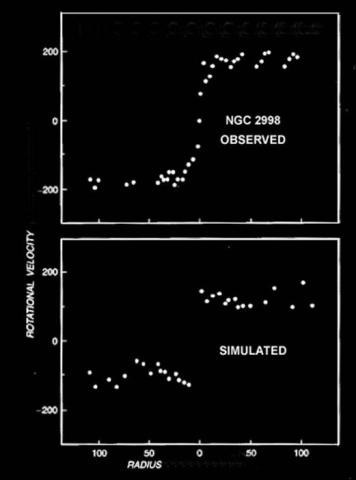
The horizontal axis of Figure 3 is the radial distance from the center of the galaxy, while the vertical axis is the speed of rotation of that part of the galaxy. The observed data are in the top graph, while the bottom graph is simulated using plasma concepts. We can see the agreement between the plasma model with actual measurements. Compare this with the disagreement between the gravitational theory and measurements, as shown in Fig. 2.
Donald Scott tells us:
[T]he principal result presented here is the revelation of the actual cause of “anomalous” stellar rotation profiles in galaxies. Since the beginning of space research, most astrophysicists have asserted that electric fields, and currents, are not important in space phenomena. Because of this rejection of electrical science and experimental plasma engineering, all efforts to explain why the outer stars in galaxies revolve around their galactic centers with velocities that, according to Newtonian dynamics, are too high have failed.
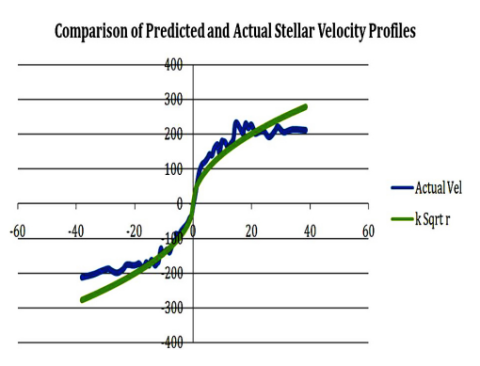
This eighty-five-year quest for a dark matter explanation of galactic stellar rotation profiles has produced only null results. Inserting a galaxy’s charge density profile into the Birkeland Current Bessel function model…now provides an elegantly simple answer shown in figure 6. 12
The figure referenced by Scott as figure 6 is reproduced below as Figure 4.
4.4) Image
5) Summary
We have seen that plasma concepts can be applied to astronomy and that they would explain at least one puzzling phenomenon, the rotation curves of galaxies.
Another point of this short article is that plasma / electromagnetic concepts are generally not well enough understood in the fields of astronomy / astrophysics / cosmology to justify the apparent omission of plasma concepts from astronomy and cosmology; nor, are those concepts well enough understood to adequately evaluate or, much less, discount those plasma / EM concepts as applicable to astronomy. Therefore, the argument against plasma astronomy, that there must be nothing to it, simply because astronomers quite often ignore or fail to invoke or even reject plasma concepts, is seen to be invalid.
There are many arguments in favor of plasma astronomy. Perhaps there will be a part 2. Stay tuned!
- 1Image source: https://commons.wikimedia.org/wiki/File:The_Twin_Jet_Nebula.jpg ESA/Hubble, CC BY 4.0, https://creativecommons.org/licenses/by/4.0, via Wikimedia Commons
- 2Because of the relationship between plasma and electromagnetism, in this paper some of the following terms may be loosely used interchangeably: plasma science, plasma physics, plasma astronomy, electromagnetic science, etc.
- 3Humphreys DR (1994) Starlight and Time, Master Books, Green Forest, AK
- 4Spears J (2014 Oct) Bias. https://tasc-creationscience.org/article/bias Accessed 2022 Oct 17
- 5One example is the galactic radial rotation velocity gradient, which plasma concepts predict, but which conventional gravitational astronomy cannot explain without extreme measures, such as invoking mysterious unobserved dark matter, or modifying Newton's laws. This is dealt with in the section Galactic rotation curves.
- 6For a summary of Alfvén’s remarkable career see: Peratt AL (1988) Dean of the plasma dissidents. The World and I. https://plasmauniverse.info/downloads/DeanOfPlasma.pdf Accessed 2022 Oct 20
- 7Alfvén H (1986) Double layers and circuits in astrophysics. Transactions on Plasma Science 14:6, 779–793
- 8Soonclaim, CC BY-SA 3.0 https://creativecommons.org/licenses/by-sa/3.0, via Wikimedia Commons. Observed data are taken from arXiv:1110.4431, from Sofue Y (2012) Grand rotation curve and dark halo in the Milky Way galaxy. Publ. Astron. Soc. Japan 64(4), 75. https://academic.oup.com/pasj/article/64/4/75/2898274?login=false Accessed 2022 Oct 21
- 9 a b Galaxy rotation curve. Wikipedia. https://en.wikipedia.org/wiki/Galaxy_rotation_curve Last edited 2022 August 21. Accessed 2021 May 23
- 10Scott D (2018) Birkeland currents and dark matter. Progress in Physics 14:2. http://www.ptep-online.com/2018/PP-53-01.PDF Accessed 2021 May 15
- 11Ho M, How the electric plasma universe creates galaxies and stars. Science in Society Archive, http://www.isis.org.uk/How_the_Plasma_Universe_Creates_Galaxies_and_Stars.php, Accessed 2021 May 23
- 12Scott DE (2018) Birkeland currents and dark matter. Progress in Physics 2(14): 57–62. http://www.ptep-online.com/2018/PP-53-01.PDF Accessed 2022 Oct 25

- Log in to post comments